
Weber County Parole vs Probation
Utah law gives the terms distinct meanings. Under Utah Code Section 77-27-1, parole is conditional release from imprisonment. The Utah Board of Pardons and Parole controls that release for a state prisoner, and the Utah Department of Corrections Division of Adult Probation and Parole, known as AP&P, supervises the person afterward. Parole does not end the sentence. It changes where and how the sentence is served.
Probation is a court's suspension of the imposition or execution of a sentence under stated terms. A Weber County probationer may have served a short jail term, left on a court order, or never entered jail at all. State felony probation is generally supervised by AP&P. A county misdemeanor case may remain tied to the sentencing court and the supervision arrangement stated in its order. That difference determines which record can confirm the status.
| Point | Parole | Probation |
|---|---|---|
| How it begins | Conditional release from a Utah prison sentence | A sentence or part of a sentence is suspended by the court |
| Controlling record | Board decision plus UDC status | Judgment, sentence, and later court orders |
| Local supervision route | UDC AP&P Region 2 Ogden | AP&P for state felony probation, or the court-listed route |
| End point | Board termination or sentence expiration | Court discharge or termination of probation |
Verify Weber County Post-Release Supervision
Start with the custody system that controlled the release. The UDC Offender Search covers people currently incarcerated by Utah or under UDC probation or parole supervision. A person released from prison on parole can remain in that search because AP&P still supervises the sentence. By contrast, a person who has fully discharged may no longer appear. A county-only booking also falls outside that statewide search.
Identity checks matter. Use an offender number when one is known, and compare all available name and status details before relying on a result. Then reconcile the search lead with the Board decision for parole or the court docket for probation. The Utah Courts Xchange system can provide district and justice court history, while a party may use MyCourtCase for eligible linked cases. A jail roster answers present custody, not the reason for supervision.
- Identify whether the release followed a county case, a Utah prison term, or a UDC community-corrections placement.
- Search UDC by exact name or offender number. Record the status wording and do not turn a blank result into proof of discharge.
- For parole, search the Board's hearings and decisions. Open the actual order rather than relying on a hearing date.
- For probation, read the sentencing court's judgment and later docket entries for the term, conditions, violations, and termination.
- Contact Region 2 Ogden AP&P to confirm that it is the correct office and ask what public verification process applies.
- If custody changed again, check the Weber roster, UDC status, or VINE and distinguish a return to custody from an office transfer.
A practical timeline lists the court or Board order, physical release, supervision start, any later warrant or violation event, and final discharge. These dates can differ without conflicting. The broader Weber County released-inmate search and record path explains how to confirm the physical exit before supervision began.
Note: A parole date, a jail exit, and the end of state supervision are three separate events with separate records.
Weber County AP&P Supervision Office
Region 2 Ogden serves Weber and Morgan counties. It is the local office route for UDC parole and state felony probation matters. Staff may need an offender number or other identifying detail to route a question, but protected case information may not be public. Ask whether the office supervises the case and which public record can confirm the current status. Do not ask office staff to interpret an unclear court or Board order as legal advice.
UDC Adult Probation and Parole
Region 2 Ogden
2540 Washington Boulevard, 5th Floor
Ogden, UT 84401
801-626-3700
The Northern Utah Community Correctional Center is another local UDC setting. A person there may be on probation or parole while living in a structured residential placement. Movement from prison into that center is not complete release from correctional control. Departure may mean a move to nonresidential supervision, successful completion, transfer, or a violation response. Confirm that event through UDC, AP&P, and Board records, not through the county jail roster.
Weber County Parole Decision Records
The Utah Board of Pardons and Parole decides whether and when an eligible Utah prisoner may be paroled and when the sentence terminates. Its Search Hearings & Decisions tool accepts first and last name, optional middle name, offender number, or a date range. Name results include known aliases. A date search can show a selected week's events and decisions. Search help is available from the Board at 801-261-6464.
The official Board search screen shows the controls and decision route used for a Weber County parole inquiry:
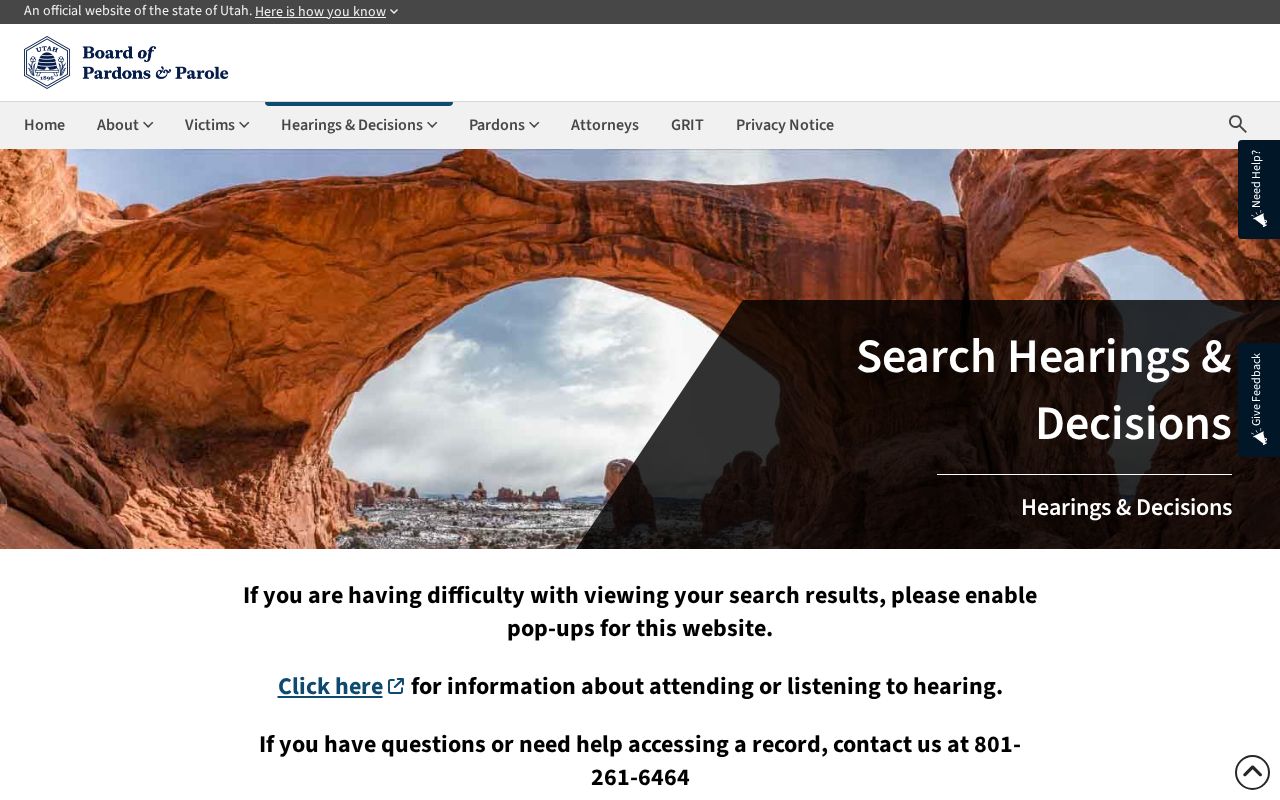
The image illustrates why the offender number is useful and why the linked decision matters more than a bare calendar entry. The Board's hearing and review types distinguish an original hearing, rehearing, paper review, rescission, violation hearing, and evidentiary hearing. Its starting-process material explains how review begins, while the decision factors describe the information considered. A rescission proceeding can remove a future date.
A hearing is not a release. The Board may publish its decision weeks later, and eligibility does not guarantee release at the first possible point. The Board separately publishes live-hearing access and calendar details. Utah Code Section 77-27-7 governs hearing and parole-date setting, while Section 77-27-9 addresses parole proceedings and minimum-term limits. Use the decision for the outcome, then confirm the prison exit through UDC or VINE.
Note: A scheduled Board hearing shows review activity, not proof that a Weber County parole release has occurred.
Weber County Supervision Violations
Conditions are the rules attached to release or probation. Their exact terms come from the Board order, court order, and supervision documents, not from a standard public list. A violation is an alleged failure to comply with those terms. An absconder is a person alleged to have stopped reporting or left supervision without authorization. Neither label should be assigned from rumor or from the mere fact that an online result changed.
AP&P may seek a Board warrant in a parole case. If the person is arrested and returned to prison, the Board's violation process controls what follows. A denied allegation may lead to an evidentiary hearing, where evidence is considered. An admission or no-contest plea follows a different track. The person can therefore have a valid prior release and also be back in custody under a later event.
Weber County Correctional Facility also books AP&P violators. A new row on the current sheriff roster can show a fresh custody episode, but it does not state the full supervision basis or final result. Compare the booking with the UDC status and Board decision. Utah VINE may supply a custody-change notice, yet a transfer notice is movement rather than release or discharge.
- Parole
- Conditional release from prison while the sentence remains under state authority.
- Probation
- Court-ordered supervision tied to a suspended sentence or part of a sentence.
- Absconder
- A person alleged to have left supervision or stopped reporting without approval.
- Discharge
- The formal end of the sentence or supervision term, shown by the controlling agency or court record.
Note: A warrant or violation entry can explain renewed custody, but only the later order establishes the case outcome.
How Weber County Supervision Ends
Parole ends through the state process, not when a person first walks out of prison. The Board may terminate the sentence, or the sentence may reach its lawful expiration under the controlling record. The UDC public search is limited to people currently incarcerated or supervised. Once a person fully discharges, an absent result can be expected and is not enough by itself to establish the date.
For an older parole matter, use the Board decision history and request the public commitment, parole, or discharge history through UDC's records process. UDC policy AG47 identifies parole or discharge dates among items that may be public, subject to record classification and redaction. For probation, the sentencing court's docket should show a termination, discharge, extension, or later violation order. The jail does not control that legal end point merely because it recorded an earlier exit.
Keep the final record chain simple. The jail or prison record proves the physical custody event. The court or Board record proves the authority and later action. UDC or AP&P establishes ongoing state supervision while it remains active. When all three agree, the difference between release and discharge is clear.
Weber County Reentry Before Release
Weber County adds a local planning layer before some jail releases. WCSO Reentry Success Services places residents within seven days of a scheduled release on a list and offers a pre-release fair each Thursday inside the correctional facility. Coordinators provide case management and release planning and connect residents with named county and community resources.
The program is relevant to supervision because a release plan can help bridge the move from custody to parole or probation. County materials identify efforts involving medication-assisted treatment, a community reentry coalition, Weber CARE, and high-utilizer coordination. Donated support may help with identification, transportation, clothing, and other needs. The page does not promise a given service to every person, so the program should be treated as a possible connection rather than a guaranteed benefit.
Reentry help also does not prove legal status. A scheduled release list is an internal planning tool, not a public release archive. Confirm parole with the Board and UDC, probation with the court and AP&P, and the actual exit with the agency that held the person.
Weber Work-Release Return Warrants
Kiesel Facility creates a distinct Weber County supervision issue. It serves work-release participants, community-service participants, and weekenders. A person may be outside the secure jail under an approved program yet still be required to return. That temporary community access is not final discharge and must not be described as a completed release.
Weber jail investigators state that they file warrants for work-release, community-service, and furloughed participants who fail to return as scheduled. This county warrant path differs from an AP&P parole warrant. The facility and underlying court record explain the Kiesel obligation, while UDC and the Board explain state parole.
When a participant's status is unclear, read the court order and ask which office holds the completion or termination record. A current jail booking can document a return to custody. It does not, by itself, show whether the person completed the earlier program or why the warrant issued.